
The Illusion of Choice: How Algorithms and Magicians Use the Same Principles
We recently performed a one-hour keynote experience called Hack the Hijack at an all-girls private school in Palo Alto, closing out a weeklong conference on the attention economy.
The audience was 300 young women growing up inside the most sophisticated influence environment in human history.
What we shared with them wasn’t a warning to “use their phones less,” or a lecture about willpower. Instead, we revealed something far more empowering about social media influence.
Much of what feels like free choice online is carefully shaped.
And once you understand how the digital distraction works, you can stop being pulled—and start choosing again.
As mentalists and magicians, the idea of reclaiming attention isn’t theoretical for us. It’s practical. It’s demonstrable. And it’s something we show live on stage.
The Illusion of Choice in the Attention Economy
In magic, there’s a concept called the illusion of choice.
An audience member believes they’re choosing freely—yet the outcome is predictable because the options were subtly framed, timed, or limited. No force. No coercion. Just guidance.
Algorithms work the same way.

When you scroll, click, pause, or react, it feels like you’re deciding what matters. But behind the scenes, systems are constantly learning:
what catches your eye
what makes you linger
what provokes emotion
what keeps you engaged
The result isn’t control—it’s curation.
And curation shapes behavior more than we realize.
As magicians, we use these principles to create wonder.
As technologists, platforms use them to capture attention.
Same mechanics. Different goals.
Why the Illusion of Choice Matters for Young Adults
Today’s youth aren’t “addicted” or “weak.”
They’re navigating an economy designed to monetize attention at scale.
Teenagers, in particular, are:
forming identity
calibrating social belonging
learning how to trust their instincts
All while being targeted by systems optimized for engagement, not wellbeing. Their greatest challenge is focus in the digital age.
That’s why we don’t believe awareness should come through fear.
It should come through understanding.
When students see how influence works—viscerally, experientially—they stop blaming themselves and start reclaiming agency.
That’s what we saw in Palo Alto.
And that’s why the room leaned in.
Five Ways to Hack the Hijack of Your Attention
In our keynote, we offered five practical tools students (and adults) can use to step out of unconscious engagement and back into choice.
These aren’t rules. They’re skills.
1. Be Intentional
Attention is directional.
If you don’t choose where it goes, something else will.
Create phone-free blocks for deep focus, creativity, or connection. Even short ones matter. Intention isn’t about restriction—it’s about alignment.
2. Understand the Emotional Hook
Content that makes you angry, outraged, or defensive spreads faster. That’s not an accident.
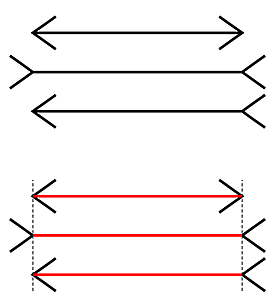
When you notice a strong emotional spike, pause and ask:
“Is this informing me—or provoking me?”
Awareness alone breaks the loop.
3. Train Focus (It’s a Skill, Not a Trait)
Focus isn’t something you either have or don’t have. It’s something you practice.
When stimulation decreases, perception increases. This is true in magic—and in life.
Even brief moments of single-task attention rebuild clarity.
4. Spot What’s Real (and What’s Engineered)
Algorithms don’t show reality—they show a version designed to hold you.
Learning to ask:
“Why am I seeing this?”
restores perspective and reduces comparison.
5. Prioritize Human Connection
No algorithm can replace real connection.
In our program, moments of genuine interaction—friends standing together, holding space for each other—were the most grounding experiences in the room.
Connection regulates attention better than any app ever could.
What Magicians Understand About Attention and Influence
Magicians don’t rely on control.
We rely on understanding perception.
When people see how easily attention can be guided, they don’t feel tricked—they feel empowered. They realize:
“If this can be influenced, it can also be reclaimed.”
That’s the heart of Hack the Hijack.
Not less technology.
Not more rules.
Just clearer awareness—and better choices.

Reclaiming Choice in a World Built to Distract
The most powerful technology on earth isn’t in your pocket.
It’s the one that decides where your attention goes.
When young people learn how the illusion works, they don’t disengage from the world—they engage with it more consciously.
And that’s not just good for students.
It’s essential for all of us living in the attention economy.
Hack the Hijack is an interactive keynote experience for schools, organizations, and communities seeking to understand attention, influence, and choice—through insight, humor, and live demonstration.
Rogers & Rizzo are professional mentalists and keynote speakers who specialize in attention, perception, and influence. Their work combines live demonstration, behavioral insight, and experiential learning.
